
The question we hear most before a first lesson is which guitar to buy. The answer depends on the music the student wants to play and on the size of the player, and each of the three main types has its own feel under the fingers.
Classical guitar
A classical guitar has nylon strings and a wide, flat neck. Nylon is softer under the fingertips than steel, so the first weeks of pressing strings hurt less, and the extra space between the strings helps fingers that are still learning where to land. It’s the guitar for classical and Spanish pieces and for fingerstyle, where the right hand plucks single strings.
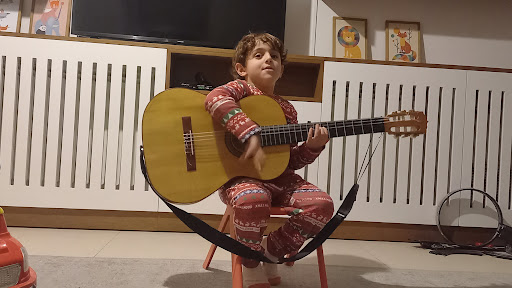
Classical guitars also come in smaller sizes, usually sold as 1/4, 1/2 and 3/4. A child who can’t reach comfortably around a full-size body will fight the instrument for posture, so for young players the size counts for more than the brand.
Acoustic guitar
An acoustic guitar, the steel-string kind, is louder and brighter. It’s the sound of most strummed songs. Steel strings press harder into the fingertips and the neck is narrower, so the first month is usually less comfortable than on a classical guitar; it gets easier once calluses form. Adults who mainly want to strum and sing along often start here.
Electric guitar
An electric guitar has thin steel strings set close to the neck, which makes notes and string bends easy to press. It has to be plugged in to be heard. At home, a small practice amplifier is enough, or headphones with a headphone amp for quiet evenings. Rock, blues and most lead playing happen on the electric. Our article on electric guitar lessons at home or online lists the gear worth having ready.

Which one, then?
Start from the music. A student who wants to play Tárrega or Malagueña needs a classical guitar. One who dreams of Bon Jovi will practise more on an electric. Someone who wants to strum and sing will be happiest with an acoustic.
For young children, a classical guitar in the right size is the usual first instrument, because nylon strings are kind to small fingers. Our aim is guitarists who can play classical music and still perform any genre when needed, and classical technique carries over well if a student moves to electric later.
The guitar isn’t the only choice. We also teach bass guitar and ukulele. The ukulele has four nylon strings and a small body, and bass suits players who like rhythm and the low end of a band.
Before you buy
Four checks count for more than the brand name:
- The guitar stays in tune through a whole practice session.
- The strings aren’t set so high above the neck that pressing them near the middle hurts.
- It fits the player sitting down, with the arm resting over the body without stretching.
- For an electric, the amplifier and cable work without crackling when the cable moves.
If there’s already a guitar at home, start with it, and at the first lesson ask the teacher whether it’s holding the student back. If you’re about to buy one, message us first with who it’s for and what they want to play.
Elias is a great teacher. He tutored my daughter beginner guitar. He was patient, kind and attentive. She loves it even more now.
Nadia S. · Google review
Lessons take place at your home in Beirut or online, on classical, acoustic and electric guitar, bass and ukulele. See how lessons work, or message us on WhatsApp to start.