
A weekly lesson shows you what to work on. The six days in between decide how much of it sticks. When a student stops progressing, the cause is usually the week: one long session the night before the lesson, or none at all.
Little and often
Fingers learn by repeating the same movement over several days. Fifteen or twenty minutes on five days does more than an hour and a half on one, and it’s far easier to fit around school or work.
Pick a fixed time if you can, such as after homework or before dinner. Keep the guitar on a stand or somewhere you can see it, out of its case; a guitar you have to unpack gets played less.
A twenty-minute session
- Tune the guitar (2 minutes). A tuner app on your phone is fine.
- Warm up slowly with this week’s scale or finger exercise (3 minutes).
- Work on the hard part (8 minutes). Find the two bars or the chord change that keeps going wrong and play only that, slower than feels necessary, until it comes out clean five times in a row. Then put it back into the piece.
- Play the piece or song from start to finish without stopping, mistakes and all (5 minutes).
- Finish with something for fun (2 minutes): a song you already know, or making something up.
A metronome helps with step 3. Set it slow enough to play without mistakes, then raise it a few beats at a time over the week.
Record yourself
Once a week, record the piece on your phone and listen the next day. You’ll hear what you miss while playing, such as a rushed run or a buzzing string in one chord. Bring what you noticed to the next lesson.
For parents of young players
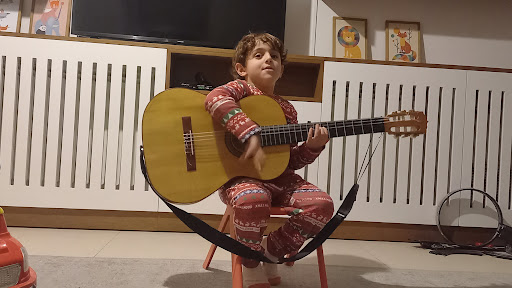
Most children don’t practise on their own at first. What works is a routine the parent sets and a short session with someone listening. You don’t need to know any music. Ask them to play what they learned this week and to tell you what the teacher asked them to fix, and praise the work (“you practised that change every day”) more than the result. A chart on the fridge, ticked after each practice, gives younger children something to see.
I have seen great progress since my son started lessons with Elias, he became re-engaged with music and with his guitar, playing more lyrically, practicing on his own and even doing shows for family and friends.
Katia B. · Google review
For busy adults
Adults usually know why they want to practise; the hard part is finding the time. Short sessions suit a full week. Ten minutes on the hard passage before work, and a longer play-through at the weekend, will keep a piece moving.
With his support and encouragement, I’m not only learning but also staying motivated and inspired to continue, while being a working mom with a very busy schedule.
Carla K. · Google review
What to ask your teacher
Our lessons follow a plan built around each student’s goals, so you don’t have to guess what to practise. At the end of a lesson, ask the teacher for the one thing that most needs work this week, and give it the eight minutes in step 3.
Lessons take place every week at your home in Beirut or online. What a guitar lesson covers explains the skills behind this routine, or message us on WhatsApp to start.